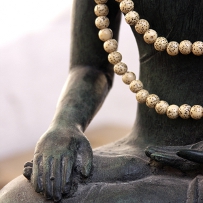
As a monk, I bring a strong commitment, along with the renunciate flavor, to the classic Buddhist teachings. I play with ideas, with humor and a current way of expressing the teachings, but I don't dilute them.
Sitting in a field of fifty to eighty people really starts my mind sparking. Since I don't prepare my talks ahead of time, I find myself listening to what I'm saying along with everyone else. This leaves a lot of room for the Dhamma to come up. Just having eighty people listening to me is enough to engage me, stimulate me, and create a nice flow of energy. The actual process of teaching evokes ideas that even I did not realize were being held somewhere in my mind.
Different teaching situations offer their own unique value. In retreat, you are able to build a cohesive and comprehensive body of the teachings. When people are not on retreat and come for one session, it opens a different window. They are more spontaneous and I'm given the chance to contact them in ways that are closer to their "daily-life mind." This brings up surprises and interesting opportunities for me to learn even more.
I'm continually struck by how important it is to establish a foundation of morality, commitment, and a sense of personal values for the Vipassana teachings to rest upon. Personal values have to be more than ideas. They have to actually work for us, to be genuinely felt in our lives. We can't bluff our way into insight. The investigative path is an intimate experience that empowers our individuality in a way that is not egocentric. Vipassana encourages transpersonal individuality rather than ego enhancement. It allow for a spacious authenticity to replace a defended personality.
I normally incorporate Qi Gong instruction in my retreats. They are not suitable as audio files but you can watch the nine videos here: https://tinyurl.com/Sucitto-qigong
Ajahn Sucitto describes how the pursuit of certainty and comfort acts as a barrier to the deep discharge of the pain of being. Discharge becomes available through allowing and handling the weight and intensities of unresolved dukkha. When approached with honesty and accuracy, there is the possibility to experience what is real, the unconditioned.
Ajahn Sucitto reflects on how ways of relating at the monastery provide training for accessing the true place of citta. In the monastery we are encouraged to get beyond self-views of “have to”, “is it good enough” and “am I worthy” so the deeper qualities of citta - warmth, generosity, gratitude - can manifest.
Ajahn Sucitto responds to a question about dana parami, describing the gift of safety that can be provided by keeping precepts and sustaining open awareness. He reminds us that in the field of dana we are also in a position to receive generosity, partaking of the good fruit we have grown.
Addressing the universal need to find meaning, Ajahn Sucitto describes how faith and wisdom work together in this search to set us free. He encourages the group, upon leaving the supports of the monastery structures and routines, to sustain forms of practice and personal protocols for wholesome actions as a way to keep one rooted in what has true meaning.
Ajahn Sucitto describes how our efforts to be good and “get it right” tend to come from a constricting place. Such efforts are accompanied by self-consciousness, criticism and stress which block access to the innate good qualities of our own heart. This talk outlines a way to move from the strategies of the head to the opening of the heart by coming into the body.
In this morning talk, Ajahn Sucitto points to a gut intelligence we all have that can be relied on to save us from the thinking mind. The thinking mind creates suffering. Our embodied (gut) intelligence is a savior, a source of safety; it always tells the truth.
In community we follow the thread of our varied interactions with others and do our best to skillfully respond to how the place of practice presents itself.